Remote Ghar
Remote Ghar
Remote Ghar
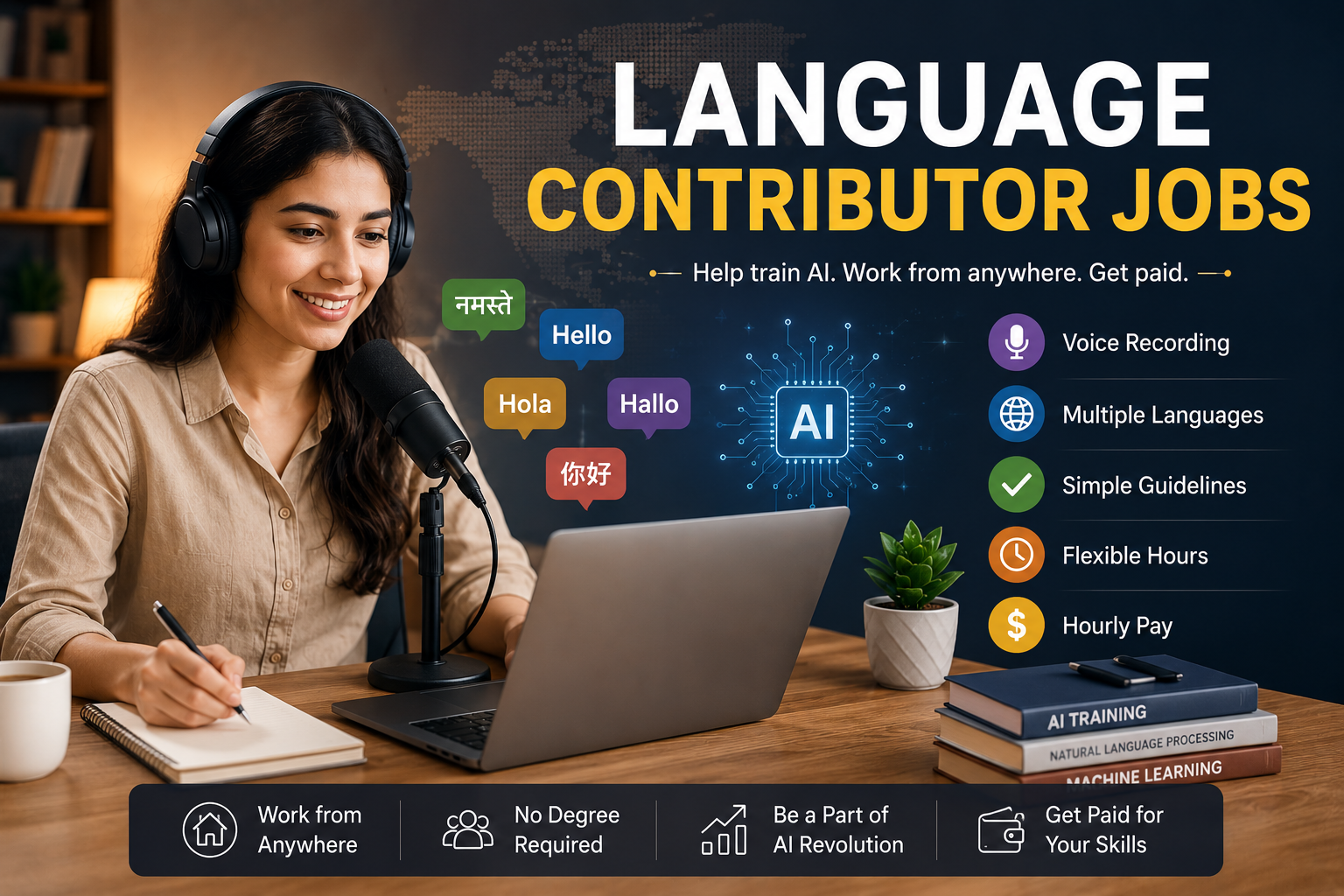
First, let's understand who language contributors are.
This refers to any language, whether Asian or European, such as German, Hindi, Spanish, or any other language.
These are individuals, specifically native speakers or those highly proficient in a local language, who contribute to AI projects.
Language contributors help train AI models in their native languages, and AI companies pay them hourly.
A great advantage of this role is that no specific degree or specialized skills are required. You simply need a strong command of your local language.

There are various roles involved, such as:
In this role, the client provides guidelines that contributors must follow while recording their voice. These guidelines typically include:
The contributor records the audio according to these requirements. The company's QC (Quality Assurance) team then reviews the recording. If the submission is approved, payment is made based on the agreed rate, either hourly or per task.

In this role, contributors work with the many AI models currently available in the market, such as OpenAI, Gemini, Anthropic, and x.ai.
These are massive LLMs (Large Language Models) that require human evaluation; for instance, analyzing a ChatGPT response, evaluating it, and rating its accuracy.
Through this process, you teach the model where it is making mistakes and what the correct output should be, thereby improving the model and increasing the accuracy of its responses.
This field encompasses several roles, such as:
This involves asking questions in your local language—perhaps about a specific location or a recipe—to gauge how well the AI model understands your input and to assess the accuracy of its response.
Since AI learns from humans to generate answers, it sometimes provides incorrect information (a phenomenon known as "AI Hallucination").
We verify the information against sources like Google to determine its accuracy and then make corrections so the model avoids making similar errors in the future.
When you ask the AI a question, it often provides two options—Response A and Response B.
We carefully read both responses, select the better one, and rate them accordingly. This helps the AI understand where it went wrong and how it can improve.
In this role, contributors check for:
This helps ensure that AI-generated content remains safe, accurate, and user-friendly.

So, friends, those were some details regarding AI Training & Evaluation roles.
Now, let's look at the next role.
Translation & Localization refers to the process of converting English content into your local language so effectively that it feels natural.
Many people consider translation and localization to be the same thing, but they are entirely different concepts with distinct functions.
Translation involves converting content from a source language to a target language without altering its original meaning.
For example:
When translating from English to Hindi:
The goal is to preserve the original meaning while accurately converting the content into another language.
Localization means that when content is translated, it should feel natural to the people of that specific country or region—as if it were their own language.
It involves adapting elements such as:
The purpose of localization is to make content feel native and familiar to the target audience rather than simply translated.
Transcription simply means listening to audio and writing it down as text.
The audio can be in any language, and the process of converting that audio into text following specific guidelines is what is known as transcription.
AI companies hire contributors to perform this task.
Now, let's get to the main point.
Assuming you have understood how the work is done and what the roles entail, let's look at where to find such work and which companies offer these roles.
Many companies offer this type of work, such as:
All these companies offer this kind of work. They essentially hire contributors to work remotely on training AI models.

Since many of you are likely ready to start working, let me outline the basic requirements so you can better understand what the job actually entails.
If you are doing language-based work, you should have C1 or C2 level proficiency.
The stronger the command of your native language, the better you will perform on their projects.
You need:
A laptop or computer isn't always mandatory, though it is required for certain tasks like reviews or ratings.
For most recording-based work, a mobile phone and an internet connection are sufficient.
Project instructions usually specify which devices can be used to complete the task.
Recording work generally falls into two categories:
This means simply recording your voice using your mobile phone without any background noise.
You cannot simply use a mobile phone for recording.
A proper recording setup is required, but the pay rate for this work is quite good.
Patience is crucial for this type of project because the guidelines are very strict.
If you do not work carefully, your submission might get rejected, meaning you won't get paid.
Therefore, always read the guidelines thoroughly before starting a project to ensure you fully understand its scope.
If you apply for a role, you will need to take a brief assessment test.
This allows the platform to gauge your proficiency in the language before onboarding you.
In today's era, the landscape of working from home has shifted significantly.
While it used to take months or years to acquire the necessary skills for remote work, the culture has evolved. AI companies are now actively seeking contributors who are familiar with diverse cultures and are experts in their native languages.
So, if you feel you have a strong command of a particular language, you too can become an AI contributor and work remotely.
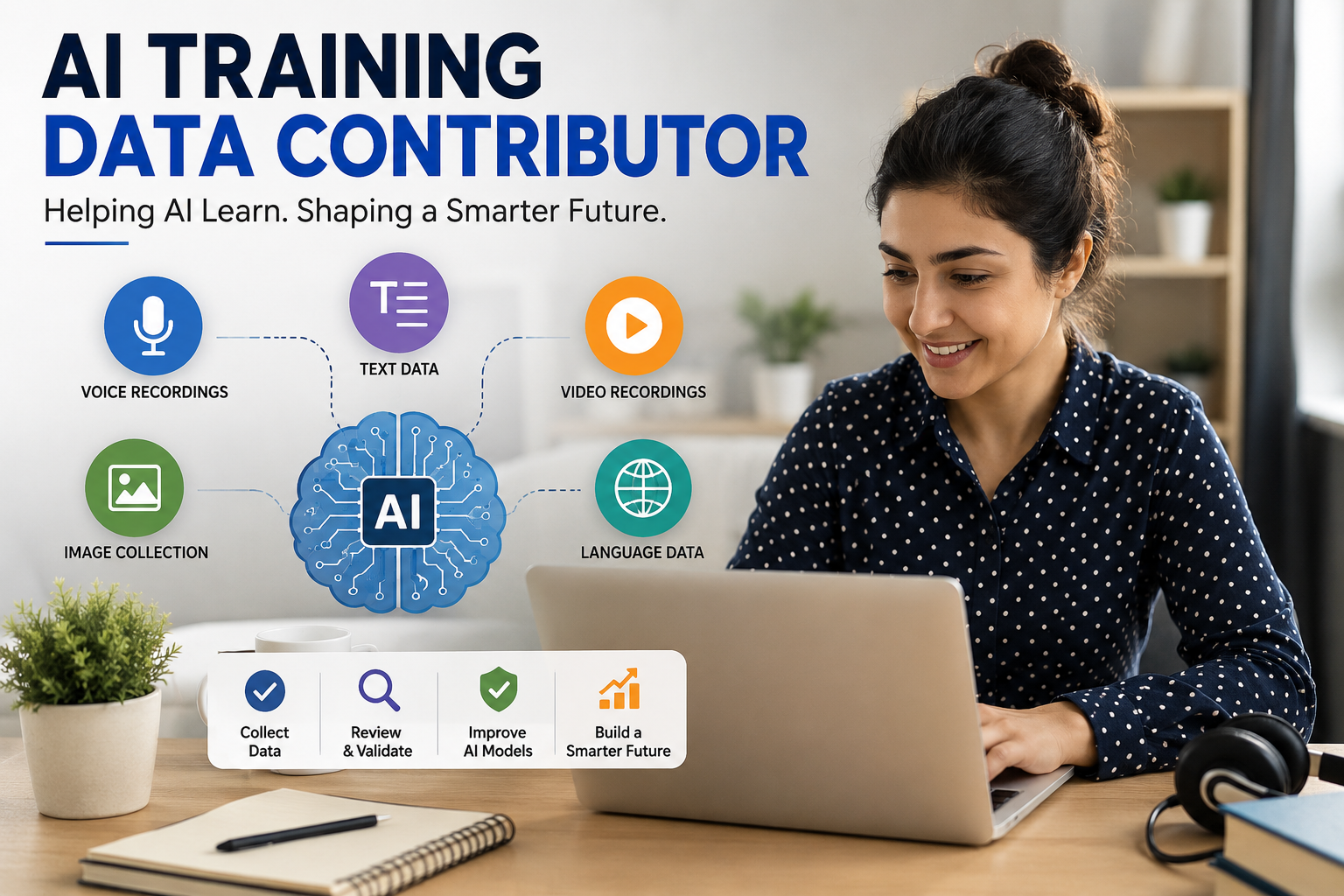
A Language Contributor is a native speaker or someone highly proficient in a specific language who helps AI companies collect, evaluate, translate, or validate language data used to train AI models.
Language contributors work on various tasks such as voice recording, AI training and evaluation, translation, localization, transcription, and data validation projects.
No. Most language contributor jobs do not require a specific degree. A strong command of your native language and the ability to follow instructions are usually the most important requirements.
AI companies regularly hire contributors for languages such as Hindi, Spanish, German, French, Arabic, Bengali, Tamil, Telugu, Punjabi, and many other regional and international languages.
Voice recording involves reading sentences or recording speech according to project guidelines. These recordings help train speech recognition systems, voice assistants, and other AI models.
AI Training and Evaluation involves reviewing AI-generated responses, fact-checking information, rating outputs, and providing feedback to improve the accuracy and quality of AI models.
Translation focuses on converting content from one language to another while maintaining the original meaning. Localization adapts the content to fit the culture, tone, and preferences of a specific region.
Transcription is the process of listening to audio recordings and converting them into written text according to specific project guidelines.
Yes. Most language contributor projects are remote, allowing contributors to work from home using a laptop, computer, or smartphone.
The basic requirements usually include:
Most companies prefer contributors with strong language skills. For language-based projects, C1 or C2-level proficiency is often recommended.
Before joining a project, you may be asked to complete a short assessment or qualification test to evaluate your language proficiency and ability to follow project guidelines.
Earnings vary depending on the company, language, project type, and location. Some projects pay hourly, while others pay per task or per completed project.
Many companies hire language contributors, including RemoteGhar, Outlier, OneForma, Micro1, Mercer, and other AI data collection and training platforms.
Yes. Many projects are beginner-friendly and require little to no prior experience, making them a good starting point for people interested in remote AI-related work.
Remote Ghar