Remote Ghar
Remote Ghar
Remote Ghar
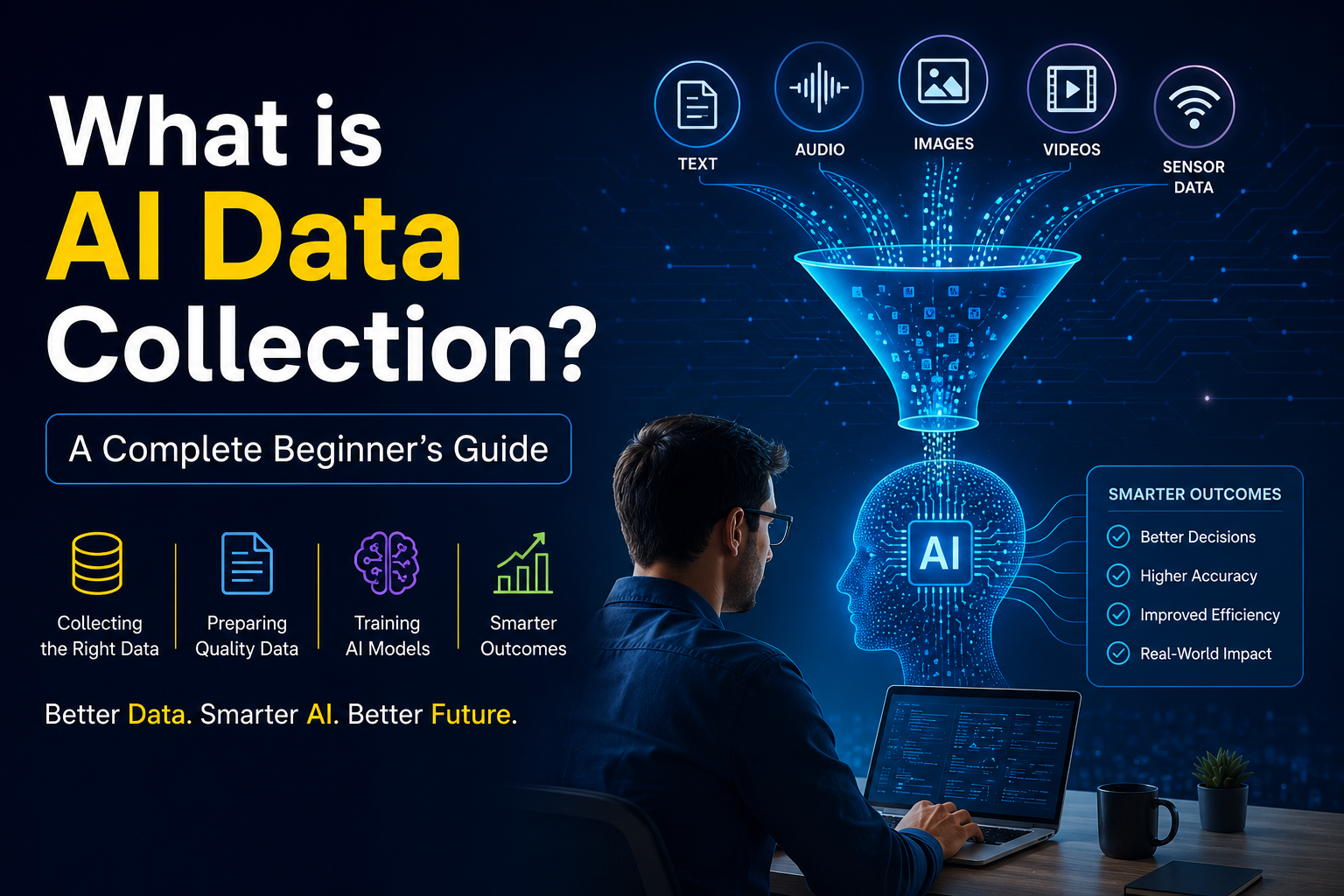
Every time you use a voice assistant, get a personalized recommendation, or interact with a chatbot, artificial intelligence is working behind the scenes. But before AI can understand speech, recognize images, or answer questions, it needs something important to learn from: data.
This process of gathering information such as text, images, videos, and voice recordings is known as AI data collection. In simple terms, AI data collection provides the examples that help AI systems learn, improve, and make accurate decisions.
In this beginner's guide, you'll learn what AI data collection is, how it works, why it's important, and the role it plays in building modern AI technologies.


AI data collection is the process of gathering information used to train, test, and improve artificial intelligence (AI) models.
Popular AI systems like GPT, Gemini, Claude, Llama, and Grok learn from large amounts of data, including text, images, audio, videos, and user interactions.
For example, to build a speech recognition system, a company needs thousands of voice recordings from people with different accents, languages, and age groups. The more diverse the data, the better the AI performs.
In simple terms, AI data collection provides the data that helps AI systems learn and make accurate decisions.
A common saying in the AI industry is:
"AI is only as good as the data it learns from."
Imagine teaching a child to identify different animals. The child learns by seeing examples repeatedly. Similarly, AI models learn by analyzing large amounts of training data.
If the data is accurate and diverse, the AI system performs well. If the data is incomplete, biased, or of low quality, the AI system may make mistakes.
This is why companies invest heavily in collecting high-quality AI training data before developing AI solutions.
Traditional data collection is often used for research, surveys, business analysis, or customer insights.
AI data collection, on the other hand, is specifically designed to help machines learn patterns and make decisions.
For example:
Although both involve gathering information, their goals are very different.
AI cannot learn on its own without examples. Every intelligent system requires training data before it can recognize patterns or make decisions.
Let's explore why AI data collection plays such an important role in artificial intelligence development.
The primary purpose of AI data collection is to provide training data for machine learning models.
When data is collected and processed correctly, AI systems can learn relationships, identify patterns, and improve their predictions over time.
For example:
Without training data, AI models cannot function effectively.
High-quality AI training data directly impacts model accuracy.
Imagine training a facial recognition system using only a few hundred photos. The system may struggle to identify faces correctly.
However, if the same system is trained using millions of images representing different ages, genders, ethnicities, and lighting conditions, its performance improves significantly.
This is why companies focus heavily on collecting diverse and representative datasets.
Bias is one of the biggest challenges in AI development.
If an AI model learns from a limited or unbalanced dataset, it may generate unfair or inaccurate results.
For example, a speech recognition system trained only on one accent may struggle to understand speakers from other regions.
By collecting diverse AI training data, organizations can reduce bias and improve fairness across different user groups.
Almost every modern AI application depends on collected data.
Examples include:
Behind every successful AI application lies a massive amount of collected and processed data.

AI systems rely on different forms of data depending on their intended purpose.
Text data is one of the most widely used forms of AI training data.
Examples include:
Text datasets help train chatbots, search engines, translation tools, and large language models.
Audio data collection involves gathering voice recordings and speech samples.
Examples include:
Audio data plays a critical role in speech-to-text systems and multilingual AI applications.
Image data helps AI systems understand visual information.
Examples include:
Image datasets are commonly used in computer vision and image recognition technologies.
Video datasets contain sequences of images along with movement information.
These datasets are used for:
Video data collection is becoming increasingly important as computer vision technologies continue to evolve.
Modern devices constantly generate data through sensors.
Examples include:
This type of data helps AI systems monitor conditions, predict failures, and automate decision-making processes.

Now that you understand what AI data collection is, the next question is: How does AI data collection work in practice?
Many people assume that companies simply gather large amounts of information and immediately train an AI model. In reality, the process is much more structured.
From defining project goals to preparing data for machine learning, every step plays a critical role in ensuring the final AI system performs accurately.
Every AI project begins with a clear objective.
Before collecting any data, organizations need to determine what problem they are trying to solve.
For example:
Without a clear goal, collecting data becomes inefficient and expensive.
Once the objective is defined, the next step is to find reliable data sources.
Organizations collect data from various sources, including:
The quality of these sources directly affects the quality of the final AI model.
After identifying sources, the actual data collection process begins.
Depending on the project, this may involve:
Many organizations also hire remote contributors worldwide to participate in AI data collection projects.
This approach helps create diverse datasets representing different languages, accents, cultures, and demographics.
Raw data is rarely perfect.
Collected information often contains:
Before training an AI model, teams must clean and organize the dataset.
This step improves reliability and ensures the AI system learns from useful information rather than noise.
Once the data is cleaned, it often needs annotation.
For example:
Data annotation helps AI systems understand what they are looking at or listening to.
This step is one of the most important parts of the AI training process.
After preparation is complete, the dataset is used to train machine learning models.
The AI system analyzes patterns within the data and gradually improves its performance through repeated training cycles.
The better the training data, the more accurate the final AI application becomes.
This is why companies continuously invest in AI dataset creation and high-quality data collection initiatives.
Organizations use various methods to collect data depending on their project requirements.
Let's look at some of the most common AI data collection methods used today.
Surveys remain one of the simplest ways to collect structured information.
Organizations use surveys to gather:
This data can help train recommendation engines and predictive models.
Many AI companies collect publicly available information from websites and online platforms.
Examples include:
This method helps create large-scale text datasets for machine learning applications.
However, organizations must ensure they follow legal and ethical guidelines when collecting online information.
Millions of users create content every day through:
This content provides valuable data that helps AI systems understand language, opinions, trends, and human behavior.
Speech-based AI systems require large amounts of voice data.
To collect this information, organizations often launch recording projects involving contributors from different countries and language backgrounds.
Examples include:
These projects are also creating new remote AI data collection jobs worldwide.
Computer vision systems need visual data to learn effectively.
Companies gather:
The collected images and videos are later annotated and used to train visual AI systems.
Many organizations use publicly available datasets to accelerate AI development.
Examples include:
These resources help startups and researchers build AI solutions without starting from scratch.
It's easier to understand AI data collection when we look at real-world examples.
Voice assistants are trained using millions of speech recordings.
These recordings help AI systems learn:
Without extensive voice data collection, speech recognition would not be possible.
Autonomous vehicles rely heavily on collected visual and sensor data.
Their systems continuously analyze:
Millions of hours of driving footage are collected and processed to improve driving accuracy and safety.
Platforms such as streaming services and e-commerce websites use user interaction data to generate personalized recommendations.
They collect information about:
This data helps AI predict what users are most likely to enjoy or purchase.
Modern chatbots and AI assistants are trained using large volumes of text data.
The data may include:
This allows AI systems to understand language and generate meaningful responses.
Healthcare organizations use AI data collection to improve diagnostics and patient care.
Examples include:
These datasets help AI systems assist doctors in identifying medical conditions more accurately and efficiently.
Remote Ghar